
PrivacyTestLab
0
Do you find this page useful?
We compared the most popular VPN providers based on privacy, transparency, independent audits, speed, streaming performance, server infrastructure, advanced security features, and overall value. These rankings prioritize privacy and long-term trust rather than marketing claims.
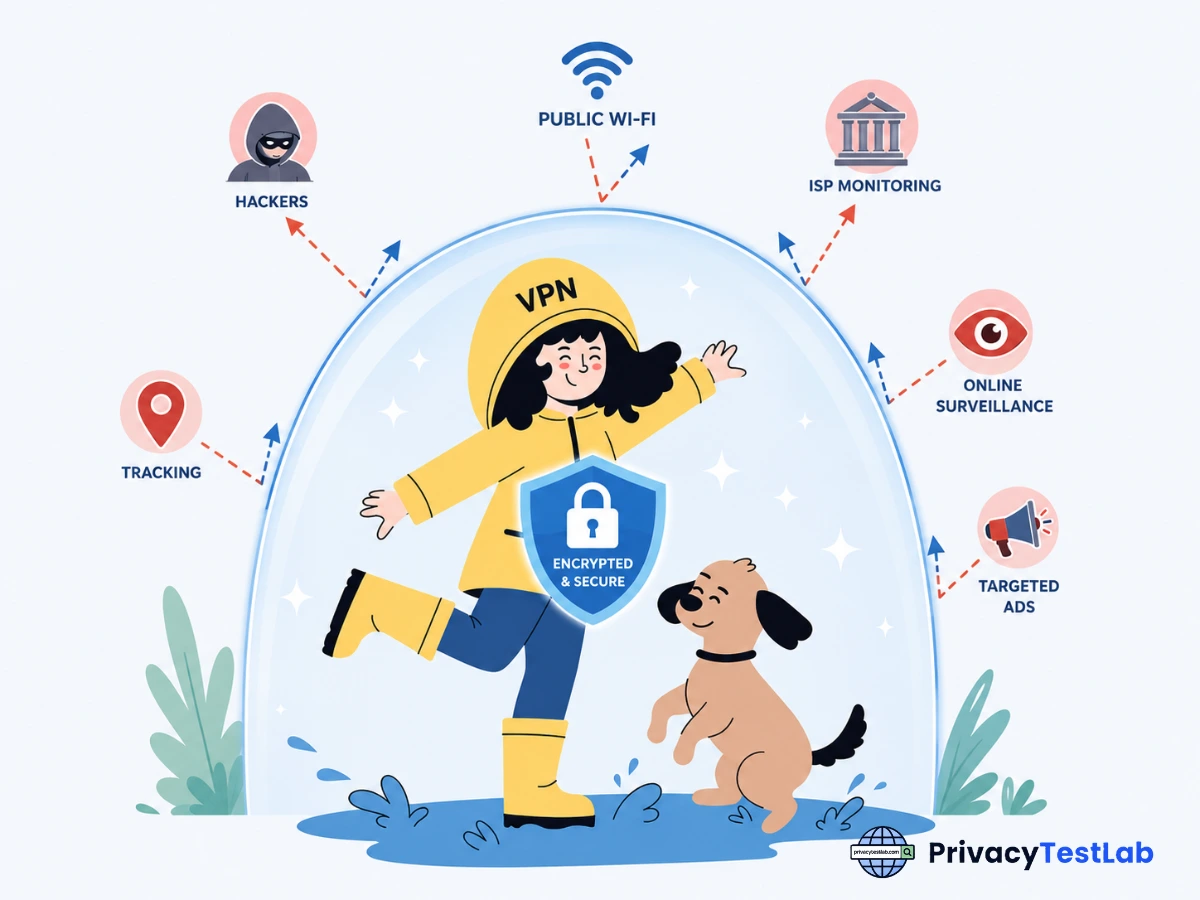 Your digital footprint is more visible than you think. A VPN creates an encrypted tunnel to hide your real network identity.
Excellent balance of privacy, speed, server network, security features and usability.
Check PriceStrong privacy reputation, open-source apps, Secure Core routing and a genuinely useful free plan.
Check PriceOne of the most privacy-focused VPN providers available, with anonymous account creation and minimal data collection.
Check Price| Feature |
 NordVPN
|
 Proton VPN
|
 Mullvad
|
 Surfshark
|
 ExpressVPN
|
 IVPN
IVPN
|
|---|---|---|---|---|---|---|
| Overall Score | 9.7 / 10 | 9.5 / 10 | 9.4 / 10 | 9.2 / 10 | 9.0 / 10 | 8.9 / 10 |
| Jurisdiction | Panama | Switzerland | Sweden | Netherlands | British Virgin Islands | Gibraltar |
| No-Logs Policy | ||||||
| Independent Audit | ||||||
| WireGuard Support | ||||||
| Kill Switch | ||||||
| RAM-Only Servers | ||||||
| Port Forwarding | ||||||
| Anonymous Payment | Crypto | Crypto/Cash | Cash/Crypto | Crypto | Crypto | Cash/Crypto |
| Free Plan | ||||||
| Streaming Performance | Excellent | Very Good | Average | Excellent | Excellent | Average |
| Torrenting | Excellent | Excellent | Excellent | Very Good | Good | Excellent |
| Starting Price | From promotional plans | From promotional plans | Flat monthly pricing | From promotional plans | From promotional plans | Monthly plans |
Rating: 9.7 / 10 | Visit NordVPN
NordVPN maintains its market position in 2026 by leveraging a combination of RAM-only server infrastructure and the high-performance NordLynx protocol. This architecture ensures that server data is non-persistent and wiped upon reboot, providing a foundational security layer for privacy-conscious users.
Rating: 9.5 / 10 | Visit Proton VPN
Proton VPN, managed by the team behind Proton Mail, is a highly regarded, privacy-focused service. Operating from Switzerland, it maintains a transparent record and is one of the few providers that offers a truly usable free plan. For premium users, it adds features like Secure Core routing and faster performance across its network.
Rating: 9.4 / 10 | Visit Mullvad VPN
Mullvad is widely regarded as a benchmark for privacy-first operations. The service minimizes data collection to the absolute technical necessity—it doesn't even require an email address to create an account. While it isn't optimized for bypassing streaming geoblocks, its commitment to anonymous payments and technical transparency makes it a primary choice for privacy professionals.
Rating: 9.2 / 10 | Visit Surfshark
Surfshark provides an effective balance between cost and feature density. Its standout feature is unlimited simultaneous device connections, which solves a major headache for multi-device households. While its pricing is aggressive, it doesn't sacrifice core security, utilizing modern RAM-only servers to ensure user activity is not stored on persistent hardware.
Rating: 9.0 / 10 | Visit ExpressVPN
ExpressVPN is often the default recommendation for users prioritizing stability and ease of use over technical configuration. Its Lightway protocol provides fast handshake times and reliable connections, which are particularly well-suited for high-definition streaming. While it commands a premium price, the consistency of its service justifies the cost for many users.
Rating: 8.9 / 10 | Visit IVPN
IVPN stands out by rejecting the standard marketing-heavy approach of the VPN industry. The company prioritizes rigorous transparency, publishing regular reports on their infrastructure and practices. It is a purpose-built tool for those who want clear, verifiable privacy rather than streaming add-ons or large-scale server networks.
Using a VPN while banking is highly recommended, especially if you log into your accounts away from home. It ensures your financial details, passwords, and session tokens cannot be intercepted by bad actors monitoring the local network layer.
However, banks use highly sophisticated fraud-prevention filters. If you suddenly log into your bank account from a VPN server located in London while your physical card was just used in New York, the security system will instantly flag your account for suspicious activity and freeze it.
💡 How to bank safely with a VPN:
To bypass frustrating verification loops, configure your app's Split Tunneling feature. This lets your banking application use your regular local ISP connection directly while keeping the rest of your web browsing encrypted through the secure tunnel.
There is no single "perfect" VPN for everyone, but looking at the landscape in 2026, NordVPN consistently takes the top spot for overall performance, closely followed by Proton VPN for sheer privacy features. The best choice depends heavily on what you intend to do most online.
👑 Quick Summary of the Top Contenders:
If your primary goal is seamlessly unblocking global streaming libraries on Netflix or maintaining low latency while gaming, go with a speed giant. If you are handling sensitive documents or routing data through highly restrictive regions, opt for an open-source tool.
It is incredibly tempting to download a completely free tool from an app store, click connect, and call it a day. However, running a massive global infrastructure of high-bandwidth servers costs thousands of dollars a day. If a company isn't charging you a subscription fee, they are making their money somewhere else.
The only exception to this rule is using "freemium" tiers from trustworthy privacy providers like Proton VPN or hide.me. These companies give you access to a stripped-down version of their paid service for free, hoping you'll eventually buy the full package. They restrict your speeds or server availability, but your core security remains uncompromised.
If you decide to spend your hard-earned money on a subscription, you shouldn't settle for baseline features. A true premium service should offer utility far beyond basic encryption.
Look for these absolute requirements when paying:
RAM-Only Infrastructures: Ensure the provider stores no operational data on spinning hard drives. If local law enforcement physically seizes a server, it contains zero readable logs.
Modern Protocols: Native integration with optimized open-source protocols like WireGuard ensures your battery consumption is low and your latency is stable.
An Automated Kill Switch: If your network connection drops for even half a second, the software must instantly cut your internet access to prevent your raw data from leaking into the open.
If a paid VPN provider doesn't transparently display audited reports verifying these three core security features, it isn’t worth your investment. Keep your criteria high and protect your digital footprint carefully.
For the vast majority of people reading this, **yes, using a VPN is 100% legal**. In the United States, Canada, the UK, Western Europe, and most of the world, a VPN is treated as a standard corporate security tool. Millions of people use them daily to connect safely to their office networks.
The only real exceptions are under highly restrictive governments. Countries like China, Russia, Iran, and North Korea either completely ban unapproved VPN software or heavily restrict their use to monitor information flow.
A traditional VPN handles **data in transit**, not data at rest. Its core job is to secure the pipe between your device and the internet, making it impossible for network interceptors to read your data. However, it cannot stop you from downloading a malicious `.exe` file or entering your bank password into a fake phishing page.
How 2026 Premium VPNs Help Control Threats
To fight this limitation, modern premium services incorporate **DNS-level blocking features** (like NordVPN’s Threat Protection or Proton's NetShield). These systems actively block connections to known malware-hosting domains, trackers, and malicious scripts *before* they can load on your machine.
While these built-in ad and malware blockers add an incredible layer of passive defense, they are not a replacement for common sense or a dedicated antivirus suite. Always verify the sender of an email before clicking internal links, even if your secure tunnel is fully active.
Don't simply rely on the green "Connected" status light inside your application. Sometimes network glitches or improper configurations cause your operating system to bypass the encrypted tunnel entirely, revealing your raw location.
Perform this quick 2-step audit to check security:
dnsleaktest.com. Write down the public IP address and the name of your ISP provider.
If your audit passes and shows only the server location you chose, your data stream is completely masked. For the highest security reliability without configuration headaches, stick to providers that implement integrated, strict leak prevention rules directly out of the box.