 Your digital footprint is more visible than you think. A VPN creates an encrypted tunnel to hide your real network identity.
Think of your standard internet connection like sending a postcard through the mail. Anyone handling it—your Internet Service Provider (ISP), network snoopers at the local coffee shop, or government agencies—can easily read where it's going and what's written on it. Your raw network address is stamped right on the front for everyone to see.
A VPN (Virtual Private Network) changes this entire dynamic by acts as a secure, armored delivery tunnel for your data. The moment you click connect, the software establishes an encrypted link between your device and a remote VPN server. Instead of going directly out into the open web, your web requests travel safely inside this encrypted tunnel.
The Identity Shift: Once your data hits the remote VPN server, the server strips away your personal routing signature and swaps it with its own. To the rest of the world, your traffic appears to originate from that secure server location, effectively masking your real-world identity.
You don't just need a VPN for hiding things; you need it because modern networks are hostile. Without one, your ISP actively logs your browsing history, networks can be intercepted on public Wi-Fi access points, and websites track your personal life for advertising profiles. If you value your digital autonomy, running structural safety checks with a reliable leak testing tool is the only way to confirm your data remains truly blind to third parties.
Every device connected to the internet is assigned a unique string of numbers known as an IP (Internet Protocol) address. Think of it less like a secure password and more like a digital return address stamped on every single piece of data you send out. It functions as your global network passport, and unfortunately, it talks too much.
While an IP address does not instantly reveal your name or exact front door location, it acts as the master key for third-party tracking. Government entities, data brokers, and marketing networks harvest this data to build permanent consumer portfolios without your explicit consent.
| What Your IP Address Reveals | What Your IP Address Conceals |
|---|---|
| Your physical ZIP code, city, and region | Your explicit legal name |
| Your precise Internet Service Provider (ISP) | Your private account passwords |
| Websites you open and files you download | Your exact house or apartment number |
The real danger occurs when your IP address is paired with tracker cookies. Advertisers tie your network location to your specific search habits, creating an eerie web where pricing for flights, hotels, and subscriptions can change based entirely on where you live.
The Corporate Track: Major advertising networks track your IP across millions of partner sites. If you look up a medical condition or financial service on one site, your IP allows completely unrelated platforms to serve you targeted ads for those exact vulnerabilities hours later.
Furthermore, bad actors on gaming platforms or public forums can use your public IP to launch localized cyber attacks, such as DoS (Denial of Service) disruption tactics. Masking this footprint isn't paranoia—it's a fundamental step in modern digital hygiene. If you're curious about what your current network profile is shouting to the world right now, you can check your live exposure status using an open IP exposure scanner to see exactly what external servers can read.
The old saying "if you're not paying for the product, you are the product" has never been truer than in the world of online privacy utilities. Building, hosting, and maintaining a global network of high-speed, encrypted servers costs a massive amount of capital. When a company offers this service for zero dollars, they have to balance their books somehow.
Premium, paid VPN services function on a transparent business model: you pay a monthly subscription fee, and in return, they provide strict data encryption, zero-logs infrastructure, and optimized server configurations. Free options, however, frequently turn to alternative monetization schemes that completely undermine the reason you downloaded a privacy tool in the first place.
The Hidden Monetization Risk: Independent security audits have revealed that a staggering number of free Android and iOS VPN applications contain embedded tracking SDKs. These tools silently catalog your app usage, browser behavior, and device metadata to sell directly to third-party data broker advertising syndicates.
Beyond data tracking risks, free services almost always come tied to strict performance restrictions. You will typically run into aggressive data bandwidth caps (often limited to a few gigabytes per month), severely throttled connection speeds, and blocked access to streaming servers.
If you are working with an absolute zero budget, your safest bet is to use a reputable "freemium" tier from a trusted, audited provider rather than a completely unverified free app from an application store marketplace. However, if your goal is long-term, seamless anonymity without constant drops or data selling risks, a premium subscription is an essential investment.
Many free options also fail basic web privacy standards by allowing structural leaks to pass through their unoptimized clients. To ensure your current security tool is actually pulling its weight, it is highly recommended to route your traffic through a dedicated WebRTC leak checking module to confirm your native browser communication elements aren't accidentally broadcasting your identity behind the scenes.
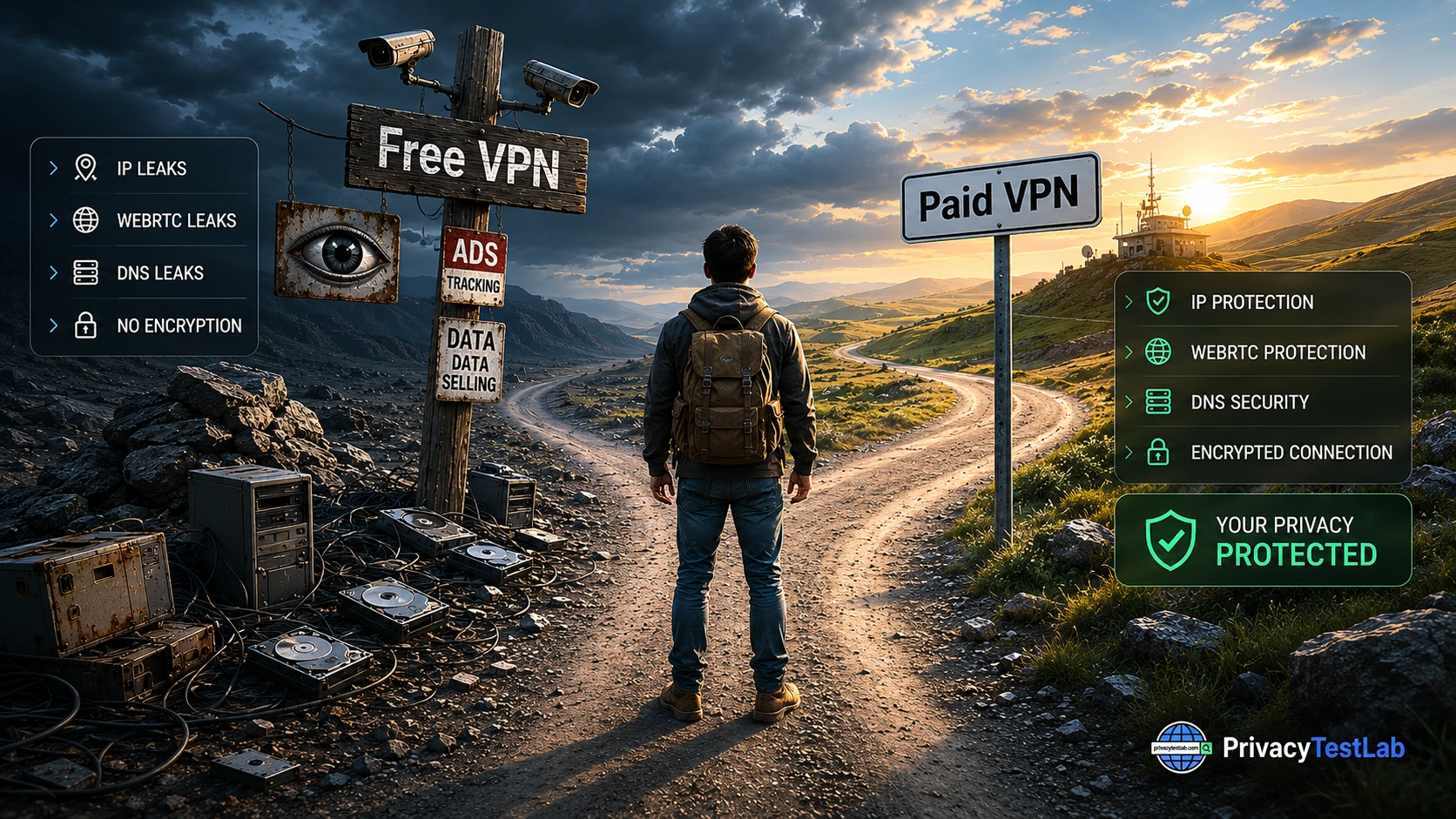 Free VPNs may limit speed, data, and privacy protections, while paid VPNs typically offer stronger encryption, better performance, no-logs policies, and more reliable security features.
It is entirely normal to experience a minor performance drop when your encryption tunnel is active. In fact, a performance loss of roughly 10% to 15% is standard for premium networks, while unoptimized providers can cut your bandwidth in half.
This drop isn't necessarily a sign that your software is broken. Instead, it is the direct mechanical result of how secure data routing functions behind the scenes:
| Performance Factor | How It Affects Your Connection |
|---|---|
| Encryption Overhead | Your device CPU must scramble every data packet before it leaves and decrypt it upon arrival, creating a slight processing delay. |
| Physical Distance | Instead of taking a direct path to a website, your traffic has to make an extra physical detour to the remote VPN server location first. |
| Server Congestion | If thousands of users are routed through the exact same server cluster simultaneously, available bandwidth splits and slows down. |
Ironically, there is one rare exception where a security tunnel can actually *increase* your browsing speeds. If your Internet Service Provider actively throttles your bandwidth during data-heavy tasks like video streaming, hiding your traffic inside an encrypted tunnel stops their tracking filters from triggering those artificial speed limits.
Just because your VPN application displays a green "Connected" icon doesn't guarantee your internet traffic is entirely safe. Configuration conflicts or browser vulnerabilities can silently leak your identifying credentials behind the scenes.
Fortunately, running a manual verification check takes less than two minutes. Follow this straightforward baseline process
to test your connection layer:
Keep in mind that a true privacy check goes deeper than checking a standard IP address. Advanced tests require inspecting your browser for hidden metadata exposures, such as scanning for WebRTC or underlying network routing failures.
The short answer is no. It is a common misconception that turning on a VPN grants you total invisibility on the web. While a VPN is excellent at masking your physical location and encrypting your data in transit, anonymity is about your entire digital behavior, not just your network connection.
If you remain logged into your personal Google, Apple, or social media profiles while browsing, those companies can easily track your activities and link them back to your identity, regardless of your hidden IP address. Your data traffic might emerge from a secure server tunnel in Iceland, but if you type your personal credentials into a website, your anonymity is immediately compromised.
Furthermore, modern trackers use sophisticated tracking techniques like browser fingerprinting. Websites look at a combination of your screen resolution, installed fonts, browser version, and hardware configuration to create a unique identifier for your device. This data collection can bypass VPN tracking shields entirely, which is why privacy advocates frequently recommend pairing a secure network connection with privacy-focused browsers like the Tor Browser or Brave.
Ultimately, a VPN provides powerful data security and location privacy, but achieving absolute anonymity requires a comprehensive approach to operational security, browser configuration, and account hygiene.
Not all privacy tools are engineered the same way. When shopping around for a reliable provider, don't get distracted by flashy marketing terms or massive server counts alone. Instead, focus on core security mechanics that directly safeguard your browsing data.
To make sure your investment actually keeps you hidden, verify that the service includes these essential components:
Focusing on these baseline technical requirements ensures you choose a tool built for true anonymity rather than just basic web unblocking.
The short answer is that while state authorities cannot easily decrypt live, properly encrypted VPN traffic, they can often trace the connection back to you through alternative investigative means. A VPN is a secure shield, but it does not make you immune to systemic tracking.
When you use a VPN, your Internet Service Provider (ISP) and any intelligence agency monitoring the network can see that you are connected to a specific VPN server's IP address. They can also log the exact timestamp your connection started and the volume of data being moved. While they cannot see *what* you are doing inside that tunnel, the mere act of using a privacy tool remains visible.
The Paper Trail Risk: If a law enforcement agency secures a court order or subpoena, they can approach a VPN provider directly and demand access to connection logs. If you choose a provider that keeps transaction data or is based in a jurisdiction with mandatory data retention laws, your historical activity can be handed over to investigators.
Furthermore, advanced agencies utilize correlation attacks. By matching the precise timing of encrypted data leaving your home router with the precise timing of data exiting a known VPN server to access a specific website, investigators can mathematically link your identity to an action without ever cracking the encryption itself.
For those facing heightened security risks, it is worth looking closely at how international surveillance networks share data. Understanding frameworks like the Five Eyes Alliance can provide critical context on how state agencies share intelligence across borders to bypass local privacy laws.
In the vast majority of the world, using a VPN is entirely legal. Most democratic nations treat encryption tools as basic digital safety utilities, much like antivirus software or private web browsers. Using a secure tunnel to safeguard your bank details on public Wi-Fi or protect corporate data is standard practice globally.
However, there is a strict divide between legal technology and illegal activity. A VPN changes your digital location, but it does not change the law. If you use an encrypted connection to download copyrighted material illegally, buy illicit goods, or execute cyber attacks, those actions remain completely illegal regardless of your hidden IP address.
Furthermore, certain highly restrictive countries like North Korea, Turkmenistan, Belarus, and Iraq have placed blanket bans on unauthorized encryption tools. Other regions, including China and Russia, heavily restrict usage by requiring citizens to use state-approved VPN clients that intentionally log activity. Outside of these specific geographic exceptions, running a personal VPN to protect your online identity is a fully protected right.