The short version
- Free plan Yes, unlimited data, 1 device
- Protocols WireGuard, OpenVPN, Stealth
- No-logs audit Audited 5 years running
- Based in Switzerland
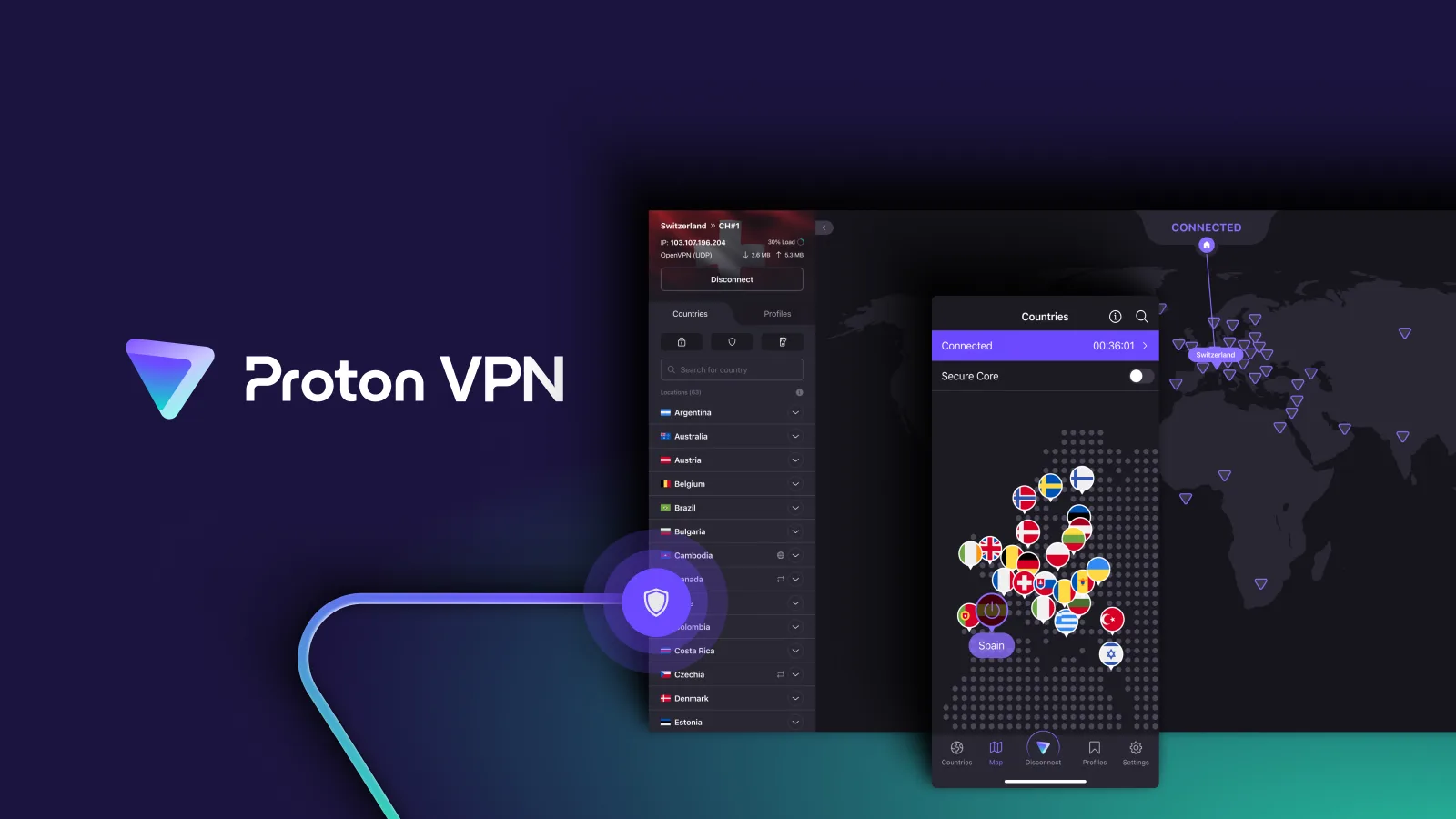
Proton VPN is built by Proton AG, the Swiss company founded by former CERN scientists behind Proton Mail. Its standout feature isn't a paid one: the free plan has no data cap, no ads, and the same no-logs policy as the paid tiers — funded by paying subscribers rather than by monetizing free users, which is the opposite model from most "free" VPNs. The trade-off is real, though: one device, a fixed set of ten countries, and none of the speed or streaming features paid plans get.
On the privacy side, Proton VPN has published five consecutive annual no-logs audits and a 2025 SOC 2 Type II attestation, all publicly downloadable. It's also one of the few major VPNs that's honest that it doesn't reliably work in China, rather than quietly implying otherwise.
What Proton VPN is
Proton VPN is made by Proton AG, headquartered in Geneva, Switzerland. The company was founded by scientists who met while working at CERN, and launched Proton Mail in 2014 before adding Proton VPN, Proton Drive, Proton Pass, and Proton Calendar to what's now a full privacy-focused product suite sharing one account login.
Switzerland has no mandatory data retention law for VPN providers and sits outside the EU and the major intelligence-sharing alliances, which is the jurisdictional argument behind most of Proton's marketing. It's a real advantage, but it isn't absolute — more on what Swiss law does and doesn't protect against further down.
Is Proton VPN free (and what does "gratis" get you)
Yes — genuinely, not just as a trial. Proton Free gives you:
- Unlimited data, with no daily or monthly cap
- Servers in 10 countries: the US, Netherlands, Japan, Romania, Poland, Norway, Switzerland, Singapore, Mexico, and Canada
- 1 device connected at a time
- The same AES-256 encryption and no-logs policy as the paid plans
What it doesn't include: Secure Core routing, the NetShield ad and malware blocker, P2P/torrenting support, streaming-optimized servers, or reliable Netflix access. Proton funds the free tier through paying subscribers rather than ads or data sales, which is a meaningfully different model from most competitors — our free VPN vs paid VPN guide breaks down why that distinction matters.
Proton VPN download for PC
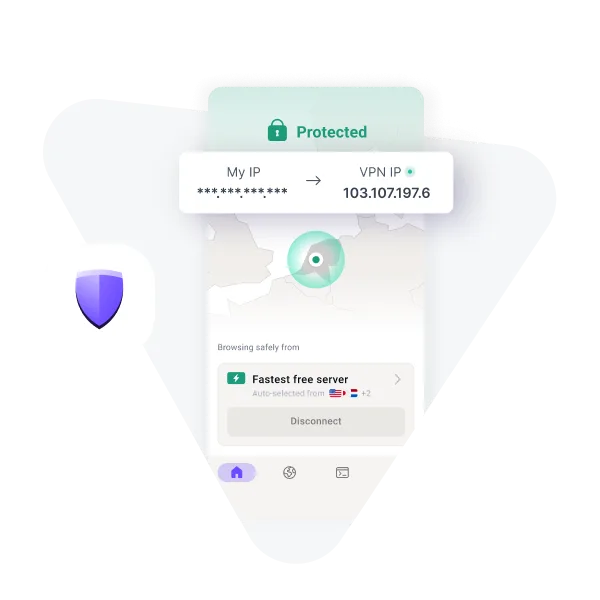
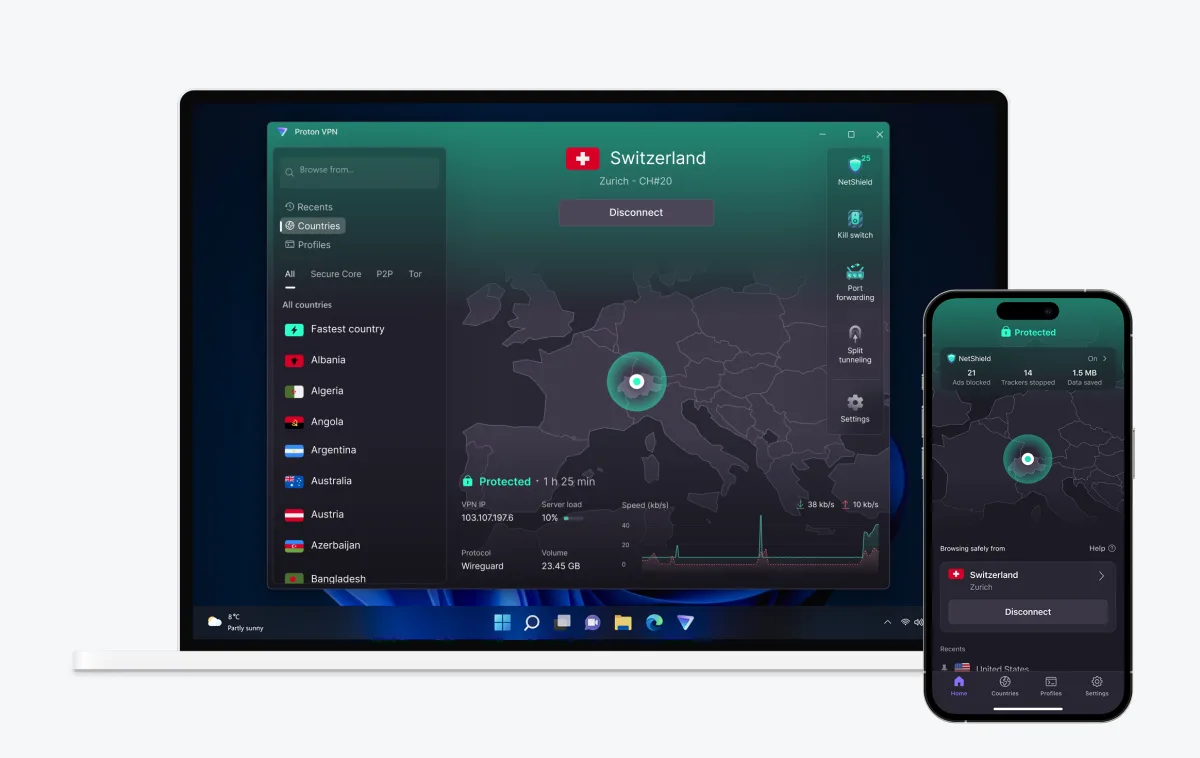
Proton VPN ships native, fully open-source apps for Windows, macOS, and Linux, all downloadable directly from Proton's own site without needing an app-store account.
Windows
- Go to Proton VPN's official download page and choose the Windows installer.
- Run the downloaded
.exeand follow the setup prompts. - Sign in with your Proton Account, or create one on the free plan with just an email address.
- Pick a country or use Quick Connect, then connect.
Mac
- From the same official download page, select the macOS version.
- Open the
.dmgfile and move Proton VPN to Applications. - Approve the network extension prompt macOS shows the first time you connect.
- Sign in, choose a server, and connect.
Linux
- Proton VPN officially supports Ubuntu GNOME and Debian GNOME, with a graphical app and a separate command-line client; it may work on other distributions with more limited support.
- Download the appropriate package for your distribution from Proton VPN's Linux download page.
- Install via your distribution's package manager (
.debfor Debian/Ubuntu-based systems), then launch the app or run the CLI tool. - Sign in and connect — the CLI client supports scripting a connection at login if you want it to start automatically.
Proton VPN download for mobile
The same account works across every device at once (up to the device limit for your plan) — sign in once and each platform keeps its own connection independently.
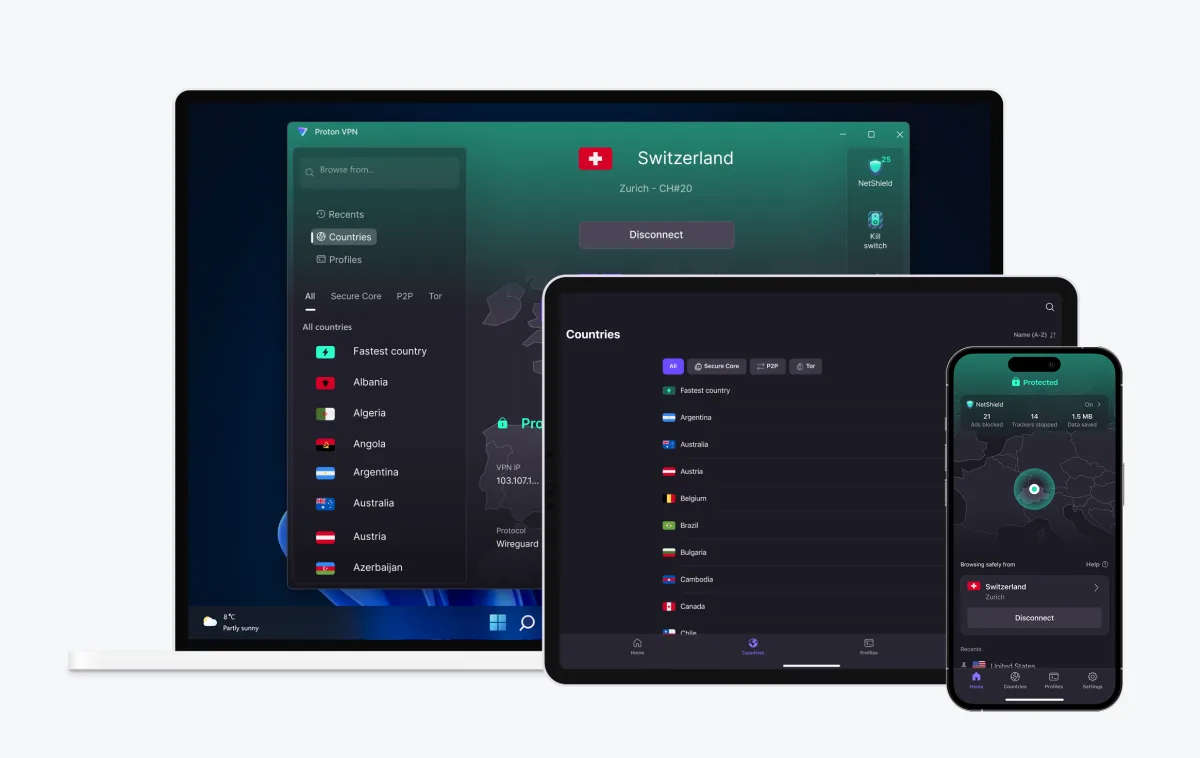
Android
- Open Google Play and search "Proton VPN," or use the link on Proton's official site.
- Install the app and grant the Android VPN permission it requests.
- Sign in or create a free account directly in the app.
- Select a server and connect — free-tier users are auto-assigned one of the 10 free countries.
iOS
- Open the App Store and search "Proton VPN," or follow the link from Proton's official site.
- Tap Get, then open the app once installed.
- Approve the "VPN configuration" prompt iOS shows on first connection.
- Sign in and connect.
Proton VPN for TV
Proton VPN has a native app for Android TV (Android 8+, or Android 7.1+ on Amazon Appstore builds) and supports Apple TV and Amazon Fire TV devices as well. Unlike the phone and desktop apps, the TV app requires a paid VPN Plus or Proton Unlimited plan — the free tier doesn't extend to TV streaming.
- Install directly from your TV's app store, or push the install from the Google Play Store on your phone or desktop and select your TV as the target device
- Sign in once using your Proton Account credentials
- Select a country with your remote and connect — the interface is built for remote-control navigation rather than a mouse
If your TV runs a Chromecast-only interface without Android TV underneath, Proton VPN won't install directly on the device — you'd need to configure it at the router level instead to cover that TV's traffic.
Proton VPN browser extension
Proton VPN offers standalone browser extensions for Chrome and Firefox. Like most VPN browser extensions, it's a proxy for browser traffic specifically, not a full-device VPN tunnel — Proton notes it requires no special browser permissions to install, which is worth checking against any extension that asks for broader access than that.
It counts as one of your device connections (up to 10 on paid plans) and supports the same server list as the desktop app, making it a reasonable lightweight option if you only need to mask your browser's location rather than your whole device's traffic.
What Proton VPN offers
- Secure Core — routes your connection through a hardened server Proton directly controls in Switzerland, Sweden, or Iceland before it exits to your chosen destination server, adding protection against an attacker who compromises a single exit server
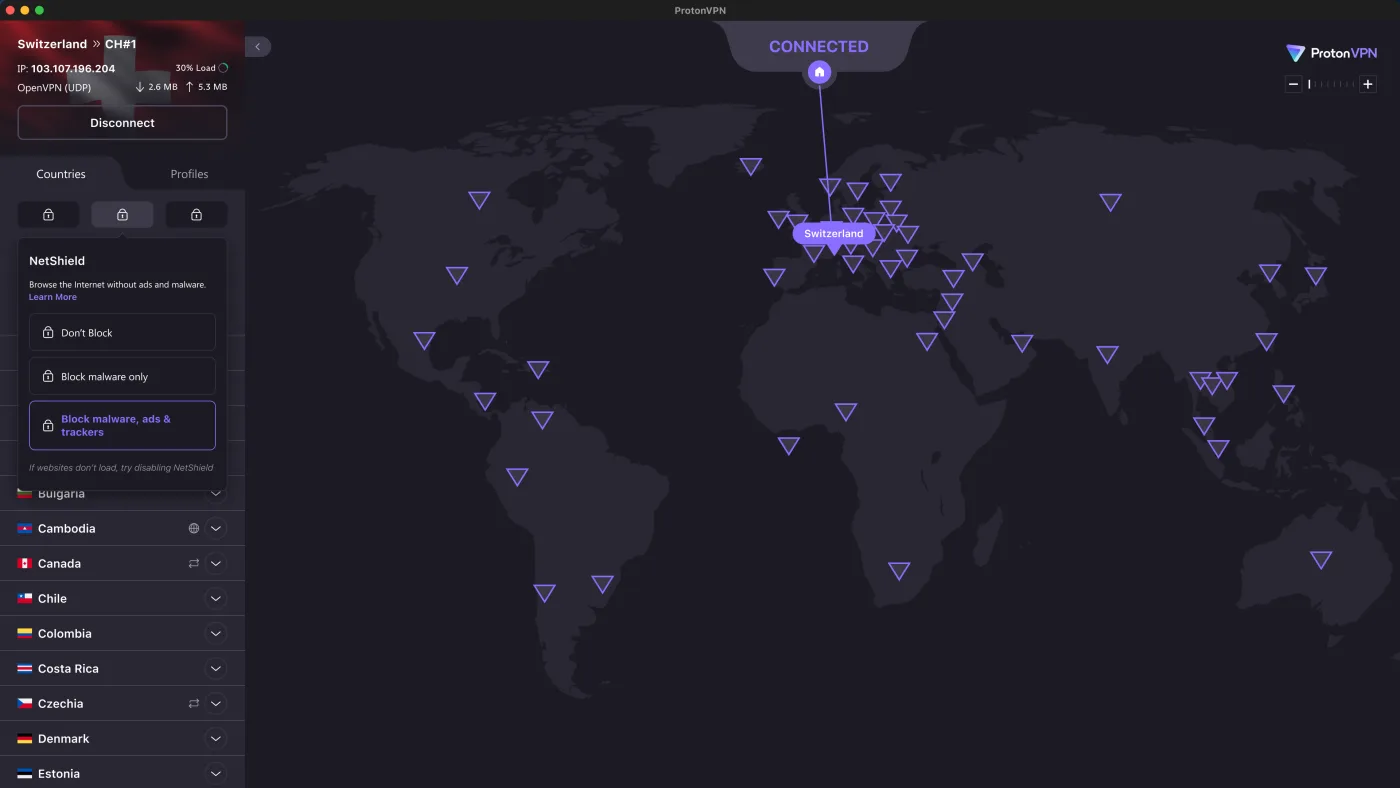
- NetShield — a network-level ad, tracker, and malware blocker with three settings: don't block, block malware only, or block malware, ads, and trackers together
- Stealth protocol — disguises VPN traffic to look like ordinary HTTPS traffic, aimed at bypassing deep packet inspection in restrictive networks
- Kill switch and split tunneling, plus port forwarding for self-hosted services and P2P
- Tor over VPN and dedicated P2P servers on paid plans
- Fully open-source apps across every platform, independently reviewable and backed by a public bug bounty program
- 20,400+ servers across 148 countries on paid plans, versus 10 countries on the free tier
- AES-256 encryption, 4096-bit RSA key exchange, and HMAC with SHA384 for message authentication
Where Proton VPN is available
The apps themselves can be downloaded and used from almost anywhere — Proton doesn't geo-restrict who can sign up or install the software. What varies is which server locations you can connect to: paid plans reach 148 countries, the free plan is limited to the 10 listed above, and a handful of heavily censored countries actively block Proton VPN's traffic on their end regardless of which plan you're on, which is a different problem from availability and covered in the next section.
Does Proton VPN work in China
Not reliably, and Proton is upfront about that rather than implying otherwise. Proton VPN was officially blacklisted by Chinese authorities on September 18, 2019, and its own support documentation states plainly that no VPN can guarantee reliable access against the Great Firewall's deep packet inspection.
In practice: Proton's Stealth protocol and alternative routing improve the odds of connecting, but success comes and goes as China's censorship systems update their detection signatures — a connection that works one day may fail the next with no warning. Hong Kong is a different case from the mainland and generally connects fine. Proton's own advice, worth following if you're travelling to mainland China: subscribe and install the app before you arrive, since both Proton's website and the login process frequently fail once you're already inside the Great Firewall.
If bypassing censorship in China specifically is your primary use case rather than a secondary one, it's worth comparing options built and marketed specifically around that — Proton VPN's own strengths are elsewhere.
Pricing and plans
| Plan | Price | What you get |
|---|---|---|
| Proton Free | $0 | Unlimited data, 10 countries, 1 device, no NetShield or Secure Core |
| VPN Plus | ~$2.99/mo (2-yr) – ~$4.99–9.99/mo (monthly) | Full server network, NetShield, Secure Core, Stealth, 10 devices |
| Proton Unlimited | ~$9.99/mo (1-yr) | VPN Plus, plus Proton Mail, Drive, Pass, Calendar and Wallet in one subscription |
Approximate pricing, checked mid-2026 in USD. Proton runs frequent promotions on long-term plans — confirm the live price at checkout.
One honest caveat worth flagging: Proton's 30-day money-back guarantee is prorated rather than a full refund on every plan — worth checking the exact terms for your specific plan and region before assuming it works identically to a flat "cancel anytime, full refund" policy.
If you're already using more than one Proton product, Proton Unlimited is usually the better math: standalone VPN Plus, Mail Plus, and Pass Plus add up close to the bundle's price on their own, so Unlimited mainly pays off once you want two or more of Proton's tools rather than the VPN alone.
Privacy, logging, and what "Swiss jurisdiction" actually means
Proton VPN's no-logs policy has been independently audited every year since 2022 by Securitum, a European penetration-testing firm whose other clients include DuckDuckGo VPN — five consecutive annual reports as of the August 2025 audit, plus a separate SOC 2 Type II attestation for operational security completed in July 2025. All reports are published in full and publicly downloadable without an account — see Proton's own published audit history.
Proton's own transparency reporting adds a specific, checkable number to that: in the first half of 2026, Proton VPN received 47 legally binding requests for user data and denied all of them — 458 total since 2017 — because the audited infrastructure holds no identifying activity logs to hand over in the first place. That's a different, stronger claim than "we have a policy": it's "there's nothing here even when a court asks."
Swiss law protects against blanket surveillance demands, but it doesn't make Proton immune to a targeted, valid court order. In 2021, Proton Mail complied with a Swiss legal order to hand over a French climate activist's account recovery IP address — Proton had that data because Mail can log a specific address prospectively under a valid order, which drew criticism at the time. That's a materially different situation from Proton VPN's own audits, which are built specifically to confirm there's no VPN activity log left to compel in the first place. It's also worth noting Proton VPN uses full-disk encryption on its servers rather than the RAM-only, diskless approach some competitors (including NordVPN, after its 2019 breach) moved to — a legitimate design difference to be aware of, even though Proton's audits haven't found evidence it results in retained logs.
Who Proton VPN is actually for
Proton VPN fits people who want the strongest available paper trail behind a no-logs claim, and who value a free tier that doesn't monetize them as the product. Journalists, activists, and anyone who wants to actually verify privacy claims rather than take them on faith get real value from the open-source code and the annual audit cadence here.
It's a weaker fit if raw speed or the lowest possible price is your main priority — independent testing consistently finds it a step behind NordVPN on throughput, and its long-term pricing sits above budget competitors. It's also not the VPN to rely on if bypassing China's Great Firewall is your primary use case; Proton is honest about that limitation rather than obscuring it, which says something about the company even where the product itself falls short.
If the audit trail and genuine free tier described above match what you need, Proton VPN's free plan costs nothing to try before deciding whether VPN Plus is worth the upgrade.
Frequently asked questions
Is Proton VPN really free, or is it gratis with limits?
It's genuinely free with no data cap, funded by paying subscribers rather than ads. The limits are real, though: one device at a time, servers in only 10 countries, and none of the Secure Core, NetShield, or streaming-optimized features paid plans include.
Does Proton VPN work in China?
Not reliably. It's been officially blacklisted in mainland China since September 2019, and Proton's Stealth protocol only sometimes gets past the Great Firewall's detection. Subscribe and install the app before travelling to mainland China, since the site and login frequently fail from inside the country.
How much does Proton VPN cost?
The 2-year VPN Plus plan runs about $2.99/month, the main upgrade tier. Proton Unlimited, which bundles the VPN with Proton's Mail, Drive, Pass, and Calendar apps, runs about $9.99/month on an annual plan. Monthly, no-commitment pricing on VPN Plus runs noticeably higher.
Is Proton VPN available for Linux and Android TV?
Yes to both. Linux has an official GUI app and a command-line client, officially supported on Ubuntu GNOME and Debian GNOME. Android TV, Apple TV, and Fire TV apps exist too, though the TV apps require a paid VPN Plus or Unlimited plan rather than working on the free tier.
Does Proton VPN's no-logs claim hold up to independent scrutiny?
Yes, more thoroughly than most competitors: Securitum has audited it annually since 2022 (five consecutive reports), alongside a 2025 SOC 2 Type II attestation, all published in full. Proton's transparency report also states it denied all 47 legal data requests it received in the first half of 2026, because no identifying VPN activity logs exist to hand over.