The short version
- Free trial 7 days, card required
- AV-TEST score 6/6/6, June 2026
- Money-back 60 days
- Owned by Gen Digital
Norton 360 is a paid antivirus suite that scored a perfect 6/6/6 in AV-TEST's June 2026 evaluation — full marks across protection, performance, and usability, the same benchmark independent labs use to separate genuinely strong engines from ones that just market well. It backs that up with one of the deepest feature bundles in the category: a VPN, a password manager, encrypted cloud backup, dark web monitoring, and — depending on the plan — full identity theft protection through LifeLock.
What most Norton reviews leave out is the company behind the product. Norton is owned by Gen Digital, the publicly traded company formed when NortonLifeLock merged with Avast in 2022 — the same Avast whose subsidiary Jumpshot was caught selling users' browsing data in 2020. Norton itself has its own history to account for: a bundled cryptocurrency miner that drew real backlash in 2022 (since discontinued), and a January 2023 data breach notification affecting roughly 925,000 accounts, including password manager users. None of that erases the product's strong lab scores. It does mean "is Norton trustworthy" deserves a fuller answer than most affiliate-funded reviews give it, and that's covered in full further down.
What Norton is
Norton is a consumer cybersecurity brand originally built around Peter Norton's antivirus software from the late 1980s, later owned by Symantec, then spun off as an independent public company (NortonLifeLock) in 2019. In September 2022, NortonLifeLock completed an $8.6 billion merger with Avast and renamed the combined company Gen Digital Inc., which now also owns AVG, Avira, CCleaner, and the identity-protection brand LifeLock. Gen Digital is publicly traded on NASDAQ under the ticker GEN, dual-headquartered in Tempe, Arizona and Prague, Czech Republic, and reports serving close to 500 million users across more than 150 countries.
"Norton 360" is the flagship consumer product line: a Windows- and Mac-first antivirus suite that bundles in a VPN, password manager, and identity-monitoring tools rather than selling malware protection as a standalone product the way some budget competitors do.
Is there a Norton free trial
Yes, Norton offers a 7-day free trial on its plans, but it requires a payment method up front and converts automatically to a paid subscription once the trial ends if you don't cancel first — there's no trial that runs without a card on file. There's no permanent free tier at all; Norton's cheapest ongoing option is a paid plan, with the 60-day refund window (covered below) functioning as the real risk-free test period rather than the trial itself.
Malware and virus scanning
Norton's scanning engine combines malware signature databases, heuristic analysis, and machine learning to catch both known and previously unseen threats. Independent testing backs up the marketing here: AV-TEST's June 2026 evaluation gave Norton a perfect 6/6/6 score — full marks across protection, performance, and usability, the same three-axis benchmark used to evaluate every major antivirus engine on the market.
The app offers four scan types, each suited to a different situation:
- Quick Scan — checks the specific system areas malware most commonly targets, typically finishing in a couple of minutes.
- Full Scan — inspects every file on the device; slower, but the only scan type that checks everything.
- Custom Scan — lets you pick specific files or folders, useful for checking a single downloaded file without a full system pass.
- Custom Task — a scheduling tool that combines temp-file cleanup, disk space recovery, definition updates, and backups into one automated routine.
A feature called Norton Insight speeds up repeat scans by skipping files already verified safe in a previous pass, which is the main reason a second full scan runs noticeably faster than the first. Two specialized tools round out the scanning suite: Diagnostic Report, which produces a full system status snapshot, and Power Eraser, an aggressive tool for stubborn malware that standard scans miss — though Power Eraser is Windows-only and, per Norton's own end-of-life notice, is scheduled to be retired with support discontinued after April 30, 2026.
Firewall protection
Norton's firewall arrives pre-configured, which matters for anyone who doesn't want to hand-tune network rules — it secures the system immediately on install, with no setup required to get baseline protection. For anyone who does want to configure it, program-level access control, custom traffic rules, and intrusion protection that blocks connections matching known attack signatures are all available in the advanced settings, alongside a one-click "restore defaults" option if a manual change accidentally weakens protection.
Ransomware protection
Norton's ransomware-specific defense, Data Protector, works on a different assumption than the rest of the suite: instead of only trying to stop malware from getting in, it assumes a breach might happen anyway and blocks unauthorized processes from encrypting files you've flagged as protected, by file type or by folder. That's a meaningful second layer specifically against ransomware, which is designed to activate after a system is already compromised — the point where a pure detection-and-removal tool has already lost.
Impact on system performance
Norton is a comparatively light background process: idle CPU use typically sits in the low single digits, with RAM usage in the low hundreds of megabytes. Resource use climbs meaningfully during a full scan, as it does with every antivirus engine, but Norton automatically suspends scans and notifications while a full-screen app — a game, a video call, a movie — is running, so it shouldn't interrupt anything you're actively doing. Independently benchmarked comparisons have found Norton's peak CPU and memory use during scans running roughly double a leaner competitor like Bitdefender's on identical hardware — worth knowing if you're running Norton on older or resource-constrained hardware, though it's unlikely to be noticeable on a modern system.
Norton Secure VPN
A VPN is bundled into every Norton 360 tier (though not the entry-level Antivirus Plus plan), using AES-256 encryption with a no-logs policy. It includes a kill switch, split tunneling, and an auto-connect feature that activates automatically on unsecured Wi-Fi. Its server network spans roughly 29 countries — a fraction of what a dedicated VPN provider like ExpressVPN or Surfshark operates, and Norton doesn't publish a server count at all, which makes it harder to judge how congested any given location might get.
Treat Norton's VPN as a genuinely useful bundled extra rather than a replacement for a dedicated VPN service if privacy or streaming access is your primary need — it's fine for general encryption on public Wi-Fi, but a much smaller, less specialized tool than something built as a standalone product. You can check any VPN's actual leak behavior yourself, Norton's included, using our own DNS leak test and WebRTC leak test.
Password manager
Norton's password manager offers unlimited password storage, auto-save and autofill, a password generator, cross-device sync, and browser extensions for Chrome, Firefox, Safari, and Edge. Its Safety Dashboard audits your saved credentials and flags weak or reused passwords with a security score — a genuinely useful nudge toward better password hygiene rather than just a storage bucket.
Two gaps are worth knowing before relying on it as your only password manager: there's no passkey support as of mid-2026, which competitors like Dashlane already offer, and the vault itself has no separate two-factor authentication option, even though your broader Norton account does support 2FA. Given the January 2023 credential-stuffing incident covered in the ownership section below — which specifically affected some password manager users — enabling 2FA on your Norton account itself, not just relying on a strong master password, is worth doing regardless of which password manager you choose.
Cloud backup
Norton includes encrypted cloud storage for backing up sensitive files, with capacity scaling by plan — from 2GB on the entry tiers up to 500GB on the top LifeLock plan in the US (storage allowances vary by region, so check your specific market before subscribing). Backups can run on a schedule or automatically whenever the system is idle, and Norton auto-detects common file types worth backing up, like documents and financial files, in addition to whatever folders you manually select.
Dark web monitoring and LifeLock
Norton's Dark Web Monitoring checks a wider range of exposed data than most competitors' equivalent tools — not just an email address, but phone numbers, physical addresses, credit card and bank account numbers, and government ID details, depending on what you register. Deluxe-tier and above adds Privacy Monitor, which scans data-broker sites for your personal information and can, on higher tiers, submit removal requests on your behalf.
In the US specifically, higher Norton 360 plans bundle in LifeLock identity theft protection, which adds live-agent-assisted monitoring, identity restoration support if you're compromised, and — depending on the tier — reimbursement guarantees for stolen funds ranging from $25,000 up to $1,000,000 on the top plan. LifeLock is a US-specific product; UK, Australian, and other international customers on equivalent-sounding higher tiers don't get the same identity-restoration and reimbursement coverage, which is worth checking carefully before assuming a "Premium" or "Ultimate" plan means the same thing in every country.
Parental controls
Norton's parental control suite runs through a separate app, Norton Family, installed on a child's device. It covers screen time limits, website and app category blocking with age-based presets, location tracking, and activity reports sent by email. It's a genuinely capable suite for the price, though — like the password manager — it lives outside the main Norton app rather than integrated directly into it.
Other Norton tools
Beyond the core features above, Norton bundles in a handful of smaller utilities:
- Software Updater — finds outdated apps with known vulnerabilities and updates them automatically, reducing one of the more common ways malware gets in.
- SafeCam (Windows only) — blocks unauthorized webcam access and notifies you when an app requests the camera.
- Norton Private Browser — a free, standalone Chromium-based browser with built-in ad and tracker blocking; it works without a Norton subscription at all.
- Optimization tools — one-click disk defragmentation and junk-file cleanup, plus a Startup Manager for disabling apps that slow down boot time.
- AI-powered Scam Protection ("Genie") — scans emails, texts, and links for phishing and scam patterns using AI, with a free public tool at Norton's Genie scam detector page you can test before subscribing to anything.
Download and setup
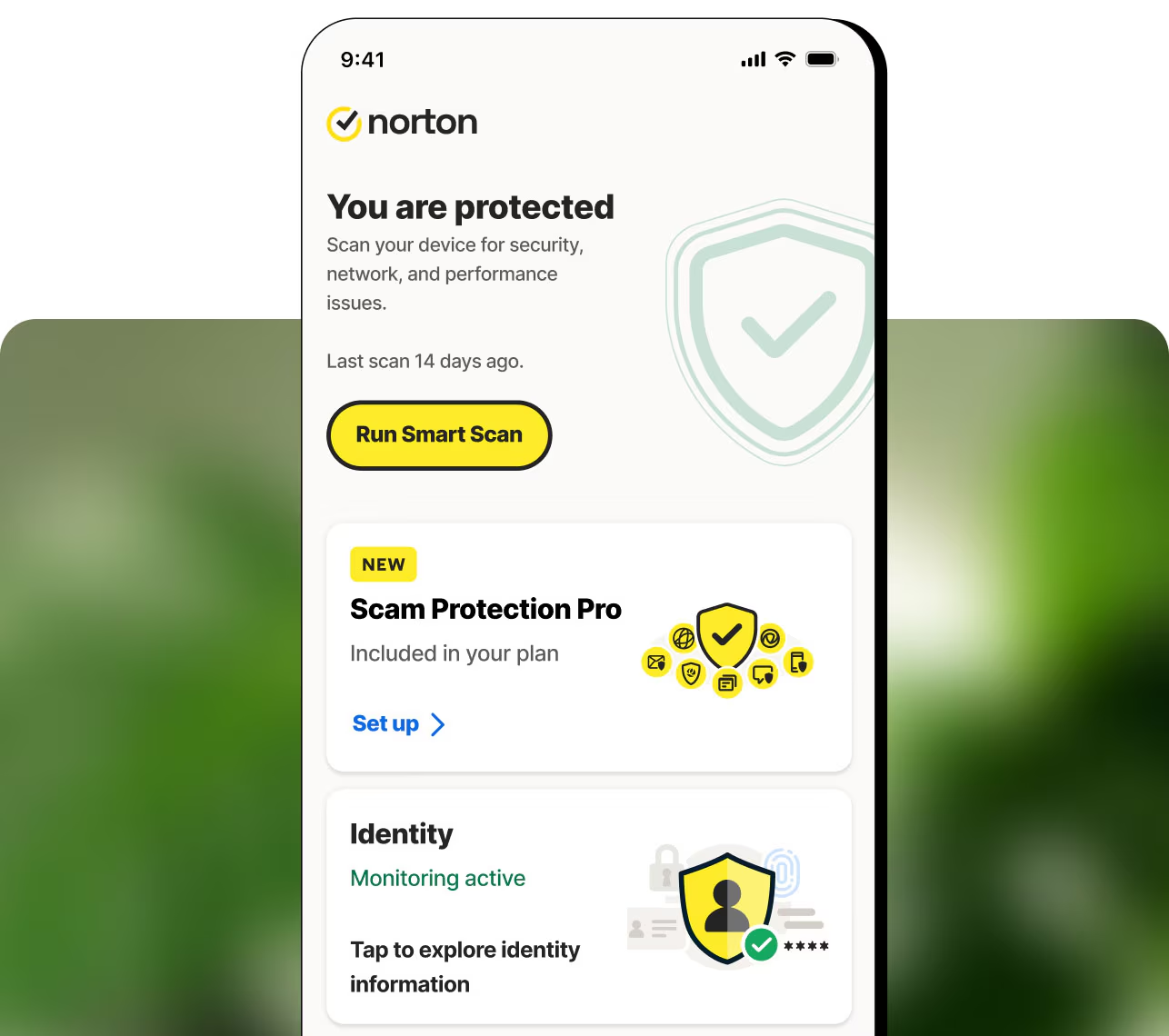
Norton's desktop apps install directly from a downloaded setup file after subscribing; mobile apps come from the App Store or Google Play. The interface splits into two modes: My Norton, a simplified dashboard covering the core features most people use day to day, and a Classic interface underneath it with deeper configuration options for the firewall, optimization tools, and scan scheduling. Some features — the password manager, parental controls, and full LifeLock identity suite — require installing their own separate apps rather than living inside the main Norton app.
Customer support
Norton offers 24/7 live chat, phone support in 40+ countries, community forums, and a searchable knowledge base. A separate paid service, Ultimate Help Desk, provides on-demand remote IT assistance for virus removal, OS troubleshooting, and system diagnostics beyond what's included in a standard subscription — worth it if you specifically want hands-on help rather than self-service troubleshooting, but a real added cost on top of your plan.
Pricing and plans
Norton runs five main tiers, and — like most subscription security software — the advertised price is a first-year promotional rate that renews noticeably higher. Pricing shifts often and varies by region, so treat this as a snapshot and confirm the live price at checkout.
| Plan | First-year price | Devices | VPN / Dark Web / LifeLock |
|---|---|---|---|
| AntiVirus Plus | ~$19.99–29.99/yr | 1 | No / No / No |
| 360 Standard | ~$39.99–49.99/yr | 3 | Yes / Yes / No |
| 360 Deluxe | ~$49.99–59.99/yr | 5 | Yes / Yes / No |
| 360 Premium | ~$54.99–69.99/yr | 10 | Yes / Yes / No |
| 360 with LifeLock (Select+) | ~$99.99–179.99/yr | 10–unlimited | Yes / Yes / Yes (US only) |
The renewal jump is the detail to plan for, not just the sticker price: independent 2026 pricing checks found Norton 360 Deluxe renewing at roughly $124.99/year after a $49.99 first-year rate — about a 150% increase. That pattern is common across the security-software industry, not unique to Norton, but it's worth calendaring a reminder to review your plan before it auto-renews rather than being surprised by the charge.
Refund policy
Norton backs every subscription with a 60-day money-back guarantee — twice the 30-day window most competitors, including Bitdefender and TotalAV, offer. Refunds are requested through live chat or phone support rather than a self-service button, and typically process within about a week.
Norton also offers a Virus Protection Promise: if a Norton agent can't remotely remove an infection from your device, you're eligible for a refund on your subscription. It's a genuinely distinctive guarantee in this category, though it comes with real conditions — a Norton technician needs remote access to attempt removal first, and the specific terms vary by subscription tier and region, so check the current policy on Norton's site before assuming a specific outcome.
Who owns Norton
Norton's current owner, Gen Digital, is a publicly traded NASDAQ company with no single controlling founder or private-equity parent — ownership sits with institutional investors and public shareholders. That's a meaningfully different structure from Kape Technologies' VPN acquisitions covered in our ExpressVPN and CyberGhost reviews, but it doesn't mean the company's history is spotless.
Three specific things are worth knowing, none of which the typical affiliate-funded "best antivirus" roundup tends to mention:
In January 2020, before the merger, a Motherboard/PCMag investigation found Avast subsidiary Jumpshot was selling detailed user browsing data harvested from Avast's free antivirus products to advertisers and analytics firms. Jumpshot was shut down shortly after the story broke. This predates Gen Digital's formation and wasn't a Norton product specifically, but Avast is now part of the same parent company as Norton, which is a relevant data point when evaluating the broader business Norton's revenue supports.
In mid-2021, Norton quietly bundled a cryptocurrency-mining feature (NCrypt.exe) into Norton 360 installs, letting users mine Ethereum in exchange for a 15% cut to Norton. It technically required opt-in, but was installed by default with every setup and was reportedly difficult to fully remove without disabling Norton's own tamper-protection feature — drawing sustained criticism through 2022 as an inappropriate feature for a security product to ship quietly. Ethereum's 2022 shift away from mining-based validation made the feature obsolete; Norton disabled mining that September and fully wound down the associated crypto wallet in 2026. It's gone, but it's a real precedent worth knowing when evaluating how Norton handles bundling decisions.
In December 2022, Norton detected an unusually high volume of failed login attempts, consistent with a credential-stuffing attack — where attackers reuse username/password pairs leaked from other companies' breaches, not a breach of Norton's own systems. The investigation found roughly 925,000 accounts were targeted, with several thousand Norton Password Manager users among those whose vault contents may have been exposed. Norton notified affected users, reset compromised passwords, and offered free credit monitoring. It's a real incident, and a useful reminder that a password manager tied to your Norton account is only as safe as that account's own password and 2FA setup — which is exactly why we flagged enabling 2FA in the password manager section above.
None of these three things overturns Norton's strong current lab scores or its otherwise capable feature set — they're a different kind of evidence than a malware-detection benchmark, and both kinds matter when deciding whether to trust a company with your identity data and passwords, not just your files.
Norton vs. other antivirus software
| Category | Norton 360 | Bitdefender | TotalAV |
|---|---|---|---|
| Entry price (first year) | ~$19.99–29.99/yr | ~$29.99–40/yr | ~$19.00/yr |
| Money-back guarantee | 60 days | 30 days | 30 days |
| System resource use | Moderate | Light | Moderate |
| VPN included | Yes (most tiers) | Limited on lower tiers | Yes |
| Identity theft protection | Yes, via LifeLock (US only) | No | No |
If raw system efficiency matters more than the identity-protection bundle, Bitdefender is worth comparing directly. If price is the only factor, TotalAV undercuts Norton's entry tier but covers a narrower feature set.
Who Norton is actually for
Norton fits people who want one subscription covering antivirus, a VPN, a password manager, and identity monitoring without shopping for four separate products — the bundle genuinely saves money over buying each piece individually, and the malware detection backing it up is independently verified, not just self-reported. The 60-day refund window and Virus Protection Promise make it a reasonably low-risk way to try a full security suite for the first time.
It's a weaker fit if you specifically want the lightest possible resource footprint, if you're outside the US and want the full LifeLock identity-restoration guarantees advertised on higher tiers, or if Gen Digital's broader corporate history — the Avast/Jumpshot episode, the crypto-miner bundling, the 2023 breach notice — matters enough to your own risk tolerance that you'd rather use a smaller, more narrowly focused competitor. None of those are reasons to dismiss Norton's core product, which tests well on its own technical merits; they're context worth having before you decide how much of your digital life to put behind one company's login.
Frequently asked questions
Is Norton 360 worth it?
For most people, yes — it combines a well-tested malware engine (a perfect AV-TEST score in June 2026) with a genuinely useful bundle of VPN, password manager, and identity monitoring, backed by a 60-day refund window. It's a weaker fit if you want the lightest possible system footprint or prefer an independently owned company over a large publicly traded one.
Is there a free version of Norton?
No permanent free tier. Norton offers a 7-day free trial that requires a card up front and converts to a paid subscription automatically, plus a 60-day money-back guarantee on paid plans as the more practical risk-free option.
Does Norton slow down your computer?
Not noticeably during normal use — idle CPU and RAM use are both low, and Norton automatically pauses scans while a full-screen app is running. Resource use rises during a full scan, and independent benchmarks have found it running roughly double a lighter competitor like Bitdefender's usage during that specific window.
Who owns Norton?
Norton is owned by Gen Digital, a publicly traded company formed from NortonLifeLock's 2022 merger with Avast. Gen Digital also owns Avast, AVG, Avira, CCleaner, and LifeLock.
Did Norton have a data breach?
Yes — in January 2023, Norton notified roughly 925,000 accounts of a credential-stuffing attack (using passwords leaked from other companies' breaches, not a breach of Norton's own systems), which affected several thousand Norton Password Manager users specifically. Norton reset affected passwords and offered free credit monitoring.
What was Norton Crypto?
A cryptocurrency-mining feature bundled into Norton 360 installs starting mid-2021, letting users mine Ethereum in exchange for a 15% fee to Norton. It drew significant criticism for being installed by default and difficult to remove. It's since been fully discontinued following Ethereum's move away from mining in 2022.
Does Norton include a VPN?
Yes, on every tier except the entry-level AntiVirus Plus plan. It includes a kill switch, split tunneling, and no-logs AES-256 encryption, though its roughly 29-country server network is much smaller than a dedicated VPN provider's.
Is LifeLock the same as Norton?
LifeLock is a separate identity-theft-protection brand also owned by Gen Digital, bundled into Norton's higher-tier US plans. It's US-specific — international customers on similarly named higher tiers don't get the same identity-restoration and reimbursement coverage.
What devices does Norton support?
Windows 7 and later, macOS 10.10 and later, Android 8.0 and later, and iOS 14.0 and later. Some features differ by platform — the iOS app has no on-device virus scanner, for instance, since iOS's sandboxed design doesn't require one.